Category Archives: Practitioners

Things you can do with a Half Moon Vector Part 2

This is the second in the series of articles looking at the variety of ways we can use the Half Moon Vector (HMV) through the legs. Let’s explore… 

How Is your client’s field organized?

This is a big topic! There are multiple signs and signals that can give you information about your client’s field. This article will focus on how available the person’s energy is.

How do you obtain the information? 

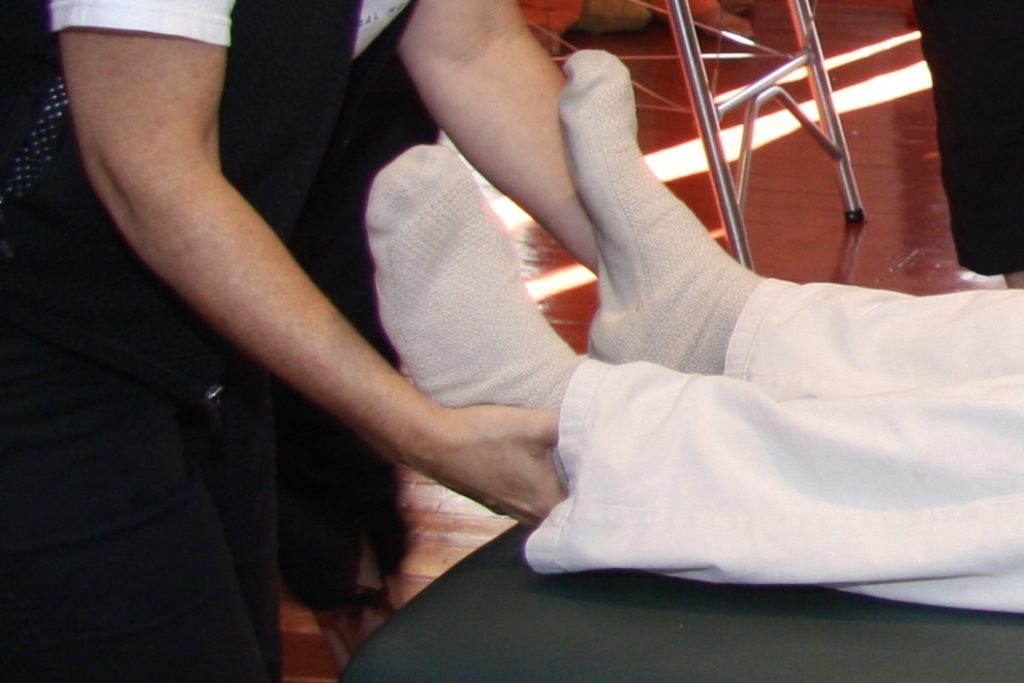
Pay attention to the weight of the client’s legs when you first pick them up. Are they too heavy? Too light? Just right?

Sometimes it’s easy to notice. You pick the client’s legs up and the weight doesn’t match the size. For example, a very small or thin person’s legs feel very heavy. Or a larger person’s legs feel very light.

Sometimes it’s the difference between the first and second HMV that gets your attention. You didn’t notice much during the first HMV, but with the second, you notice the legs seem to feel lighter or heavier. 

How can you use this information to guide your session? 

Because we know the balance between structure and energy improves as we move through the session, a change in either direction means an improvement. If the legs have become lighter, it’s likely the field was more contracted or congested during the first HMV. If the legs have become heavier, it’s likely the person was somewhat disembodied earlier in the session. In both instances, more energy has become available to the client. The client has become more available to themselves.  

Once we identify the field is contracted or the person is disembodied, we can tailor our ZB session more directly to their needs. A contracted field often responds well to a more expansive session, more energetic touch, longer fulcrums, longer pauses. Embodiment can be facilitated by a more structural touch and shorter, peppier sessions. There are also specific fulcrums that may help, such as the field fulcrums from Geometry of Healing. The acetabular field fulcrum or moving the field through the hip can encourage embodiment while fulcrums that open windows are very expansive.   

A case example: 

Many years ago I worked with a client who had suffered a severe stroke that paralyzed the left side of her body. She’d made a remarkable recovery and had regained her ability to walk. She described knowing that she was much better but still feeling paralyzed on the inside of her body. She wanted her inside experience to match her outside experience. In her first ZB session, during the first HMV, I was struck by the difference in the weight of her legs. Her left leg was way too light, while her right leg felt fairly normal. Her left side was disembodied. By the end of that session, her left leg had filled in just a little. With each subsequent ZB session, her left leg “gained weight.” And it was amazing to watch her progression! After 8 sessions, the weight of her legs felt equal and she said she felt normal, inside and outside. 

This is important. My main focus was to give her a good Core ZB, just like we learn in ZB I and II. I paid particular attention to the HMVs so I could track the changes in the growing embodiment of her left side. What I did not do is try to make her legs feel equal when I gave her an HMV. 

How might you improve your skills?

Every week, choose one or two sessions in which you pay particular attention to the weight of the client’s legs, noticing any changes between the first, second, and last HMV as well as changes across several sessions. Have fun and let me know how it goes!

What is knowing?

Have you ever wondered how, during a ZB session, you just know something? For example, you just know when to move on from a pause, or that you need to do an extra pass through the ribs? How did you know? Let’s have a cup of tea or a glass of wine together and think about this! [Read more]

Is it because we have knowledge we aren’t aware of, gained through experience? Years ago, I spent July 4th with friends, including a great little 8-year-old boy. There was a sudden thunderstorm in the early afternoon and he became distraught because he thought that meant there would be no fireworks that evening. The adults tried to comfort him by saying, “Don’t worry. The storm will be over long before the fireworks start.” His response was, “But how do you know?” 

That question made me reflect on how I did know. And I realized I knew because I’d lived through many more summers than he had and knew from experience that summer storms in Boston can come and go fairly quickly. 

So there’s an argument to be made that once you are experienced giving ZBs, there are things you may know without being consciously aware that you know. And becoming more conscious about what your experience tells you may deepen the presence and skill you bring to your ZB sessions. 

What about those times when you just know and, even with reflection, can’t put your finger on why? 

I had this type of experience once while working with a Physical Therapy home care patient. He wasn’t feeling well and although his vital signs were a little low, there didn’t seem to be anything significantly wrong. I called his doctor and his doctor agreed that things seemed OK. But something still felt off to me. Before we ended the call, the doctor asked, “What does your gut tell you?” I replied, “I think something’s very wrong.” Based on my answer, the doctor instructed the patient to go to the Emergency Room. It turned out the patient in fact had something seriously wrong and his trip to the hospital helped him receive timely and critical medical treatment. 

I don’t know how I knew. I still don’t. What I do know is I had a body-felt sense that somehow lent credence to my knowledge and helped me trust it. I still remember that feeling, although I don’t think I can describe it. I can, however, recognize it when it happens. 

So while we may not be able to figure out how we know, it may be possible to identify internal feedback signals that happen at the same time. So perhaps we can identify when we know!

Lastly, I’m curious about the beliefs we may have about this knowing. My own belief is that knowing does not elevate me or make me particularly special or skilled. I believe this type of knowing experience is available to all of us. The trick is recognizing the experience and trusting that it’s real. Keeping an open mind and waiting to see if you get any confirming feedback. I also think it’s important to focus on remaining in service so the experience is less about you and more about your client. 

Do you get a body signal when you “just know” something? Do you receive information but don’t trust it? Are you clear that you are at Interface, meaning you know what’s yours and what’s theirs? Do you have a belief that other people might have this ability but you don’t, thus disempowering yourself? Food for thought!

I hope you find this process of self-reflection worthwhile!  Let me know how it goes!

Things You Can Do With A Half Moon Vector

This is the first in a series of articles looking at the variety of ways we can use a Half Moon Vector (HMV) through the legs. Each article will introduce one thing you might want to explore, the signals to watch and feel for, why it might be helpful, and an example from my own experience with clients. 

In this first article, let’s explore… 

Does the client’s energy move quickly or slowly?

This is one of the first things I focus on when I’m getting to know a new client. I often use it to guide some of my decisions for the remainder of that first session as well as for subsequent sessions. It may be that the client’s energy moves neither quickly or slowly but somewhere in between. In this case, I likely won’t modify the session based on this criteria.

How do you obtain the information? 

Once you have the first HMV in place, shift your attention to feedback signals that indicate your client’s energetic response. How long does it take to see a working sign? Do you see one at all? What do you feel in your hands? 

If you see a working sign almost immediately, it likely means your client’s energy moves quickly. With clients like this, you may even notice a deep breath during the sitting assessment. If it takes a long time to see a working sign or you don’t see a working sign, it’s possible the client’s energy moves slowly. 

Focussing on what you feel in your hands, if energy starts to come into your hands almost immediately, this indicates, as you might surmise, the client’s energy moves quickly. Conversely, if you feel that nothing is happening or maybe sense just a little movement as you are completing the fulcrum, this indicates a slower energetic response. 

It’s important to note that energy that moves quickly is no better or worse than energy that moves slowly. It would be like saying blue eyes are better than brown eyes. It’s simply an aspect of your client’s world that can be helpful to pay attention to. And don’t forget, every client is unique so you may have clients that don’t fall neatly into either category. 

How can you use this information to guide your session? 

There are several means available. Here are a few to try: modify the length and pace of your session as well as using a more structural or more energetic touch. You can also make use of fulcrums that add compression or change the direction of your rib fulcrums to increase containment or expansion. 

Clients whose energy moves quickly frequently benefit from shorter sessions without long pauses. Usually a structural touch feels better to this client and is more helpful. These clients may also be very sensitive and they may deplete easily. A shorter, brisker session with lots of structure can help because it contains their energy and can help them to feel their edges. Fulcrums that utilize compression and increase containment are usually very helpful as well. 

Conversely, clients whose energetic response is slower may do better with slower sessions, slower fulcrums, more and/or longer pauses and a more energetic touch. Angling your rib fulcrums to increase expansion can also be very helpful. Compression fulcrums are not usually helpful, although may be with particular clients. 

A case example: 

I had a client several years ago whose energy moved very slowly. I didn’t pick up on this right away. She had come to me for help with hip pain. I found the acetabular field in her painful hip a bit thin, so I used the bubblegum fulcrum from Geometry of Healing. Compression. She came in for the next session in more pain. Looking back, had I paid more attention to how her energy moved, I might not have chosen that fulcrum even though my evaluation indicated a need for it. She turned out to be a client that taught me a lot about working with slower moving energy. As our work together progressed, I used more energetic touch, performed fulcrums more slowly and added more and longer pauses. As I modified my sessions, she did better and better. 

How might you improve your skills?

Every week, choose one or two clients to practice this with. You may already have someone in mind!  Try adapting your sessions and see what happens. You’ll be surprised at how quickly you master this aspect of Half Moon Vectors. Have fun and let me know how it goes!

In the next issue, we’ll look at using the beginning of the ZB session to get a sense of how well your client’s field is organized. Stay tuned!

Highest Personal Regard and Compassion

Have you ever wondered about the difference between compassion and highest personal regard? Is there a difference? Let’s have a cup of tea or a glass of wine together and think about this!

The focus of this conversation is to look at what highest personal regard and compassion means to each of us and where each comes into play in our everyday lives. There may be no definitive answers; just hopefully intriguing questions applied to our own personal experiences. 

I began wondering about this one day when leading a pyramid meditation. I noticed the body- felt-sense I had when feeling high personal regard for myself and others. And I noticed the body-felt-sense I had when connecting with compassion while pausing in the heart chakra. They weren’t the same and I wondered about that. 

Over the years, like so many of us in the Zero Balancing community, I’ve strived to embody the principle of high personal regard, to live the practice with my students, clients, colleagues, family and friends. It’s the way I approach meeting anyone new. It’s the way I’d like to be approached. My high personal regard is theirs to lose. 

Repeating that last sentence: my high personal regard is theirs to lose. Can one lose this? Are there times when it’s not possible to hold someone with highest personal regard, without judgement or comparison as it’s described in the Core ZB Study Guide? 

What if someone hurts you? What if someone is intentionally aggressive and seeks to cause harm? Are they deserving of high regard? 

Here’s another scenario…If your intent is to hold someone with high regard, but your instinct, your donkey, is sending out warning signals, which should hold sway? Do you ignore your instinct in favor of the idea of high regard? Is high regard the same as trusting someone? 

Now let’s look at compassion and ask the same questions: can someone lose your compassion for them? Are there times when it’s not possible to have compassion for someone? If they’ve hurt you are or are causing harm intentionally? Does having compassion mean trusting someone? Ignoring your instinct? 

Here are the results of my own pondering of these questions: Compassion and High Personal Regard are not the same. Certainly not the same on a visceral level for me. Can someone lose my high personal regard? 

I will apply this question to a specific situation in which someone was unfortunately aggressive and unkind toward me. Did my donkey send out warning signals? Yes. Did I override those warning signals? I’d say it took me awhile to recognize the warning signals and once I did, I listened. And yes, I met this person and held them in high regard and, if I’m honest with myself and with you, I can say they did lose my respect and high personal regard. I felt some shame about that; like I had somehow fallen short. I believed that if I was more evolved and embodied high regard better, I could manage to still hold them in high esteem despite their behavior. When I look back from this vantage point, I’m not so sure that’s true and… that’s how I felt at the time. 

However, when it came to compassion, they could not lose my compassion. When I connected with their true being, underneath the hurtful behavior, I could feel the depth of their suffering and felt and still feel deep compassion for them. In fact, it was by connecting with compassion that I was able to forgive them, free myself, and move on.  

I hope you find this process of investigation worthwhile!  Let me know your thoughts! 

Strictly Blue Line Ballroom

The ZB principle in the Spotlight in this issue is the Blue Line. In a Zero Balancing session, we include coming to the Blue Line as part of getting into position to do a fulcrum. It’s the last step before initiating the fulcrum. We, as practitioners, take the looseness out of the structure until we first connect with the consciousness of our client. We have knocked at their door and they have opened it. We pause. We experience each other and can begin meaningful communication. 

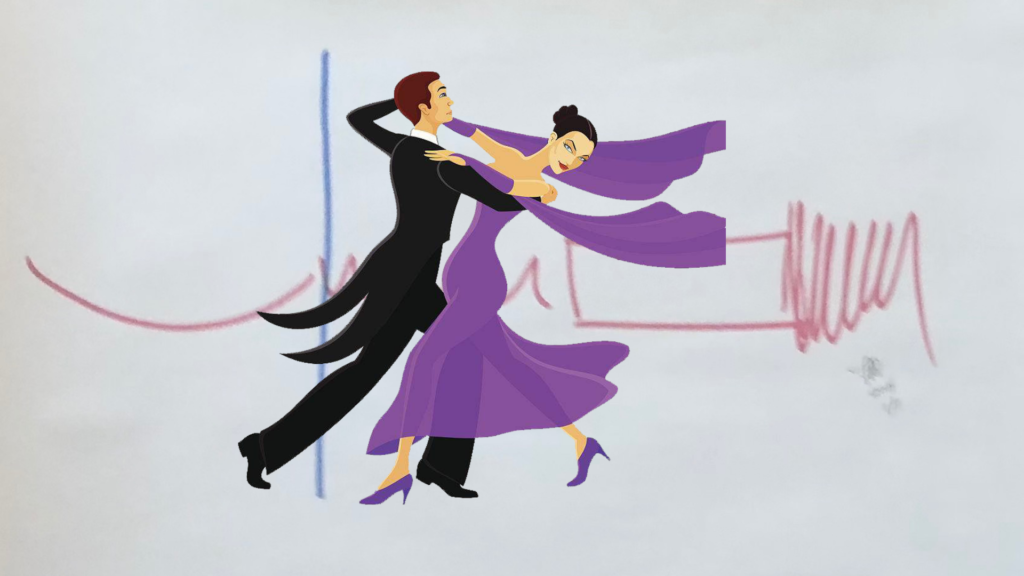
As with so much in ZB, the principles can be applied to life at large. For example, many years ago I decided to pursue a long held dream…to learn ballroom dancing. (the “read more” here)  I gathered up my courage and started attending beginner level ballroom classes at a local dance studio. Fox Trot, Rumba, Cha Cha, Salsa. As a novice ballroom dancer, I found myself adrift in the unknown territory of right-foot-back and quick-quick-slow; learning dance steps with names like Hesitation, Promenade, and…I kid you not…Pretzel and Hairbrush. Out there on the dance floor Frank Sinatra was singing it his way and I was desperately trying to figure out which of those steps my partner was leading me to do. Despite my best efforts, when he headed east I would invariably head west. 

Then one evening, the instructor, a sweet Cuban man alive with grace and style, began to talk about how to communicate through touch. 

He said there has to be some tension in the man’s right arm, his hand on the woman’s left scapula. The woman must lean slightly into the man’s hand in order to help maintain that tension as they both move; that tension must be maintained so there can be meaningful conversation. Sound familiar? AHA!!! The Blue Line!! If the tension is dropped, he said, the communication is dropped as well. The woman can’t tell where the man is leading her. There’s no engagement. There’s no dancing. 

As soon as I recognized the principle, I began to concentrate on staying at the Blue Line with my dance partner. And as I danced with different partners, the parallels with giving ZBs continued. I learned that finding the Blue Line was different with each partner…just like finding the Blue Line is different with each client. One partner might hold me with lots of tension in his arms. Similar to clients whose structure has less give, there wasn’t much looseness to take out and I found the Blue Line by adding just a little tension. If I leaned too hard, I blew past it and it felt like we were fighting each other. Another partner’s arm felt quite loose. To feel his lead, I needed to add more tension. Perhaps we have all experienced a similar situation with a client whose tissue is extremely flexible. Because I needed to adjust to each partner as an individual to stay in communication, I discovered the most successful approach was to be curious about where I might find the Blue Line. And as you might imagine, I find this approach most successful in finding the Blue Line with my clients. 

So the next time you give a ZB, I invite you to use your curiosity as you come to the Blue Line, for example at the first Half Moon Vector. You might not find it the first time, but you will certainly find clues as to what to try the next time. If you use too much tension and go past the Blue Line, note it to yourself and try less tension the next time. Perhaps in that fulcrum, you don’t use enough tension to take out the looseness. Try adding a little more tension when getting into position for the next fulcrum. You get the idea. By the end of the session, you’ll likely have a pretty good idea of how to find the Blue Line in this particular client. And the more you approach positioning for your fulcrums this way, the more adept you’ll become at both the Blue Line and the fulcrums. Enjoy the process! And dance on…